
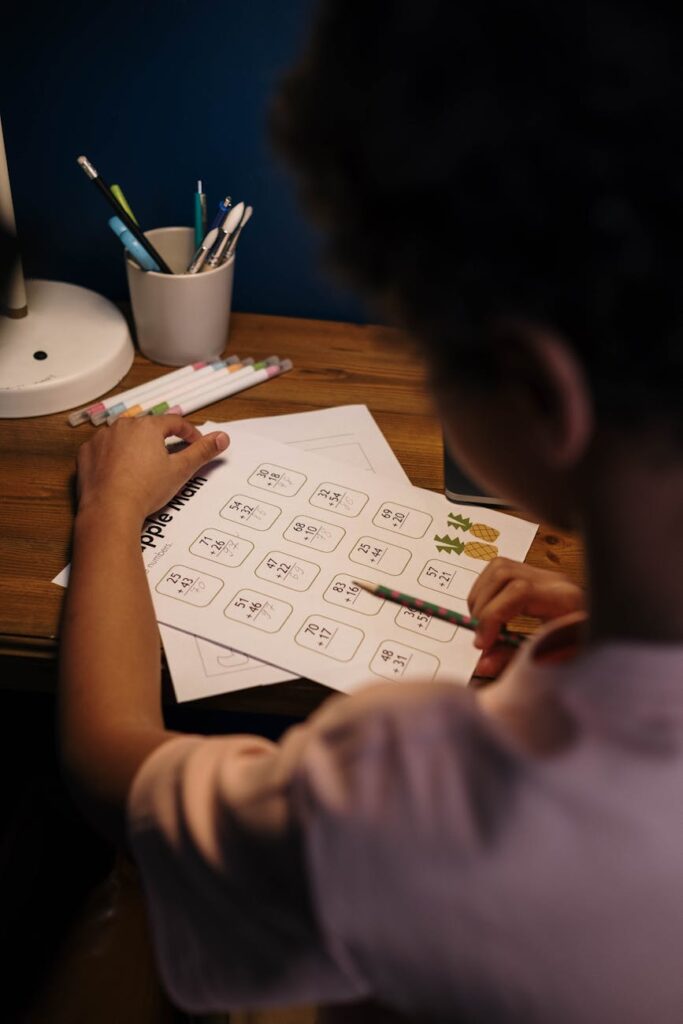
How to help a child struggling with math at home starts with one simple shift: stop treating the problem like a talent issue and start treating it like a skills-and-confidence issue. A child who melts down over homework, guesses instead of working through problems, or says “I’m just not a math person” is usually reacting to frustration, not lack of ability.
Related resource: How to Help Your Child with Homework Without Doing It.
If you’ve been sitting beside your child wondering why something so basic feels so hard, you’re not alone — and you’re not failing them. By the end of this, you’ll have a clear, practical plan that makes math feel less like a battle and more like something your child can actually improve at.
[Important: The information in this article is for educational purposes only and does not constitute medical advice. Every child and family is different. Always speak with your pediatrician or a qualified medical professional before making any health-related decisions.]
Table of Contents
Why math feels so big at the kitchen table

The hardest part of helping a child struggling with math at home is that the problem rarely looks like just math. It looks like tears over a single worksheet, endless procrastination, stomachaches before homework, or a child who suddenly “forgets” everything they knew yesterday.
That’s because math difficulty often sits on top of something bigger: shaky number sense, gaps in earlier skills, reading comprehension issues, working memory strain, or math anxiety in kids. The National Center for Learning Disabilities notes that math struggles can show up in many different ways, and not all of them mean the same thing. One child may need more repetition. Another may need a different explanation. Another may need support for an underlying learning difference.
Here’s the part parents often miss: when math feels unsafe, the brain stops learning well. A child who is tense, embarrassed, or ashamed won’t absorb new steps the same way a relaxed child will. That’s why the emotional tone at home matters just as much as the worksheet.
This matters because the goal is not to “save” every homework session — it’s to change the experience of math itself, starting now.
How to help with math at home starts with the right problem
The biggest mistake parents make is assuming every math struggle means the child needs more practice. Sometimes they do. But often they need a different kind of practice, not more of the same thing.
Research from the National Mathematics Advisory Panel and decades of classroom experience point to a few common roots: weak foundational skills, limited fluency, and trouble connecting math facts to meaning. If a child can’t confidently count by twos, regroup numbers, or see why 6 + 4 = 10 in a visual way, harder work becomes a wall instead of a next step.
And here’s a surprising truth: parents often overestimate how much “explaining” helps and underestimate how much “showing” helps. Many kids understand math better when they can use counters, drawings, number lines, or real objects. That’s not babyish. It’s how the brain makes abstract ideas concrete.
Key supporting point: A child who misses one early concept can look “bad at math” for years, even though the real issue is one small gap that never got patched.
Key supporting point: Anxiety can make a capable child blank out; this is one reason math anxiety has been studied as a real barrier to performance rather than a simple attitude problem.
Key supporting point: Reading can quietly interfere with math homework, especially when word problems are involved. If your child solves calculations fine but freezes on word problems, language may be part of the issue.
Key supporting point: Repeating the same worksheet over and over often builds fatigue, not mastery. Better practice is shorter, targeted, and tied to the exact skill that’s missing.
The good news? Once you identify the real barrier, you can stop fighting the wrong battle and start helping in a way your child can feel.
A simple plan for how to help a child struggling with math at home
You do not need to become a math teacher. You need a repeatable routine that lowers stress and makes thinking visible. Start here.
- Do a 5-minute skills check: Ask your child to solve three very small problems without pressure — one they can do easily, one that’s just a little harder, and one from current homework. Watch where they hesitate. That tells you whether the issue is facts, steps, or understanding.
- Use a “show me” tool: Keep pennies, beads, Lego bricks, index cards, or a simple number line nearby. When your child gets stuck, have them build the problem instead of staring at it. This is especially helpful for early elementary math and regrouping.
- Break homework into tiny rounds: Try 10 minutes of work, 2 minutes of movement, then 10 more minutes. Short bursts reduce shutdown and make it easier to stay engaged.
- Say the math out loud together: Have your child explain each step in plain language. “First I added the tens, then I counted the ones” is more useful than silent guessing. You’re teaching sequence, not perfection.
- End with one win: Finish every session with a problem your child can solve successfully. That last feeling matters more than people realize. It helps the brain associate math with competence instead of dread.
If homework usually ends in tears, don’t start by making it longer. Start by making it smaller, calmer, and more visual.
What the research says about math anxiety and confidence
Parents are often told to “just make it fun,” but confidence is not fluff — it’s part of the learning process. A large body of research shows that math anxiety can interfere with performance by draining working memory, the mental workspace kids use to hold steps in mind. The American Psychological Association has written extensively about this effect, and it’s one reason a child may know the material but still freeze on tests or homework.
Another useful clue comes from education research on mastery learning: kids improve faster when instruction is targeted to the exact gap, instead of being pushed ahead before the base is solid. The National Center for Improving Literacy also emphasizes that strong foundational skills matter for later success across subjects, not just math.
There’s also a quieter issue many families miss: elementary math is cumulative. If a child struggles with place value in second grade, fractions in fourth grade can feel impossible later. That’s why intervention works best when it’s early and specific.
What This Actually Means for You
If your child is anxious, avoid framing mistakes as “careless.” To them, it may feel like danger, not carelessness. If they’re frustrated, the answer is usually not a bigger worksheet — it’s a smaller target, more support, and more chances to succeed visibly. And if the struggle has been going on for a while, it may be time to ask the school or a specialist for a closer look instead of assuming it will fade on its own.
The most important takeaway is this: confidence and skill build each other. When one improves, the other usually follows.
Common mistakes parents make when their child hates math
Most parents mean well. But a few habits can accidentally make math feel heavier than it already does.
Mistake #1 — Explaining it louder: When a child doesn’t understand, many adults repeat the same explanation with more words and more urgency. That usually backfires. Try a different representation instead: draw it, build it, act it out, or find a simpler version of the same skill.
Mistake #2 — Rushing to the answer: If you solve every hard problem for them, your child learns relief, not math. Instead, give one hint at a time and let them do the next move. That keeps them engaged without making them feel abandoned.
Mistake #3 — Saying “I was bad at math too”: This sounds comforting, but kids often hear it as a life sentence. A better line is: “Math is a skill, and skills grow with the right kind of practice.”
Mistake #4 — Practicing the same worksheet over and over: Repetition only helps if the child is practicing the right thing. If they keep missing regrouping, for example, they need targeted support on regrouping — not 20 more problems that all feel like punishment.
Mistake #5 — Turning homework into a nightly power struggle: When every math session becomes a fight, the emotional load gets bigger than the academic one. Set a start time, a stop time, and a calm routine. Predictability lowers stress for both of you.
Once you stop these traps, you create space for the strategies that actually work.
When to get more help for math difficulties in children
Sometimes the issue is bigger than what can be fixed at the kitchen table. If your child has persistent difficulty learning math facts, struggles far below grade level, or shows intense distress that doesn’t improve with support, it’s time to ask for help.
Formal evaluation may uncover dyscalculia, attention issues, or another learning difference. The Child Mind Institute offers a helpful overview of dyscalculia and why it’s often missed because it can look like general “bad at math” behavior. If you’re seeing a pattern across months, not just a bad week, don’t wait and hope it evaporates.
Also watch for signs that the struggle is affecting sleep, mood, school avoidance, or self-esteem. That’s no longer just a homework issue. That’s a child carrying stress that deserves attention.
If you’re unsure whether what you’re seeing is normal, your pediatrician, teacher, school counselor, or a qualified learning specialist can help you sort through it. A quick check now can save years of frustration later.
Why math support is becoming more important every year
Math is not getting less important. From budgeting and coding to healthcare and trades, numeracy touches almost everything. At the same time, many schools are still catching up from learning disruptions and uneven skill development, which makes home support more valuable than ever.
One forward-looking shift is the growing use of adaptive math tools and tutoring platforms that tailor practice to a child’s exact level. Done well, these tools can help fill gaps faster than generic homework ever could. The catch: they work best when an adult helps keep the child calm, consistent, and honest about where they’re stuck.
“The hardest part of learning math is not doing math. It’s believing you can.” — a principle echoed across education psychology research
That’s why now matters. The families who do best are usually not the ones who know the most math — they’re the ones who notice the struggle early and respond without shame.
What happens next is simple: the earlier you steady the emotional piece, the faster the academic piece can move.
Math help at home questions parents ask all the time
Why does my child understand math in class but not at home?
Some kids hold it together at school and fall apart in the safe space of home. That can happen because they’re exhausted, embarrassed, or finally relaxed enough to show how hard it feels. If this happens often, look at timing, fatigue, and anxiety — and mention the pattern to your child’s teacher or pediatrician if it’s affecting daily life.
How much math practice should my child do at home?
Usually less than parents think, but more consistently. Short daily practice is often better than one long, painful session. If your child is melting down, reduce the amount and focus on one skill at a time.
What if I’m not good at math myself?
You do not need to be the expert. Your job is to be the calm guide who helps your child think through the problem, not the person who already knows every answer. If it helps, use videos, manipulatives, or teacher-provided examples — and ask for support when you need it.
How do I know if my child might have dyscalculia?
Possible signs include persistent trouble with number sense, basic facts, sequencing, or understanding quantities, even with practice. A formal evaluation is the best way to know for sure. If the pattern worries you, bring it to your pediatrician or school team so you can look at it early and carefully.
How to help a child struggling with math at home without losing your mind
How to help a child struggling with math at home is really about two things: finding the actual barrier and making practice feel safe enough for learning to happen. That means less pressure, more visuals, shorter sessions, and a lot less talking over the same problem in the same way.
Your child does not need you to be perfect. They need you to be steady, observant, and willing to try a different route when the first one fails. Start tonight with one tiny win: pick a single math fact or problem, use objects to show it, and end the session while your child still feels capable.
That small shift can change the whole tone of math at home.
And if the struggle feels bigger than homework, trust that instinct and reach out to a qualified professional for guidance.
You’re not behind, and your child isn’t broken — you just need the right next step.