
Bassinet to crib transition is one of those baby milestones that looks simple on paper and feels weirdly huge at 2 a.m. One night your baby sleeps fine in a tiny cozy bassinet, and the next you’re staring at a crib like, “Why does this suddenly seem like a trap?”
If you’ve been googling when to move baby from bassinet to crib and getting a dozen conflicting answers, you’re in the right place. By the end of this, you’ll know exactly how to make the move with less stress, fewer tears, and a lot more sleep.
Table of Contents
Section 1: The Real Problem — Why This Is Harder Than It Looks
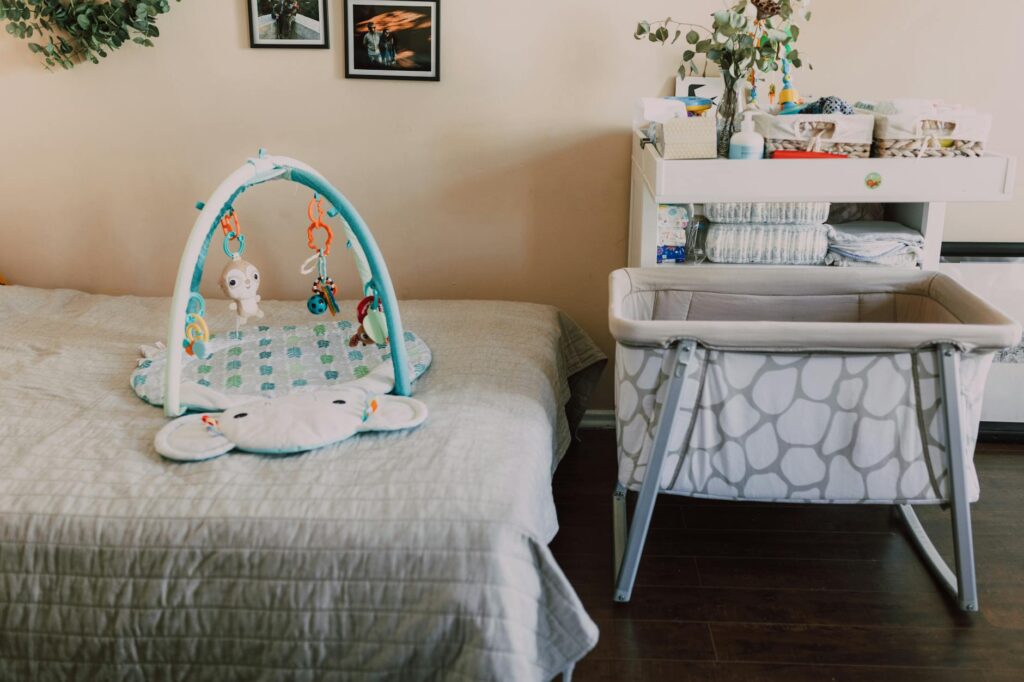
The bassinet to crib transition is hard because you’re not just changing furniture. You’re changing your baby’s sleep environment, their sense of closeness, and often your own anxiety all at once. That’s a lot for one tiny human — and honestly, a lot for you too.
Most parents wait until the move feels “safer” or “easier,” but the timing usually gets complicated fast. Bassinets have weight limits, movement restrictions, and narrow comfort windows. The American Academy of Pediatrics safe sleep guidance recommends room-sharing without bed-sharing for at least the first 6 months, while many bassinets are only usable for a much shorter stretch.
That’s why families often end up with a baby who’s outgrowing the bassinet but not yet thrilled about the crib. And when a baby won’t sleep in crib, everyone feels it — the baby gets overtired, you get desperate, and bedtime turns into a negotiation nobody wanted.
One more thing: the crib is often in a different visual and sensory category for your baby. Bigger space. Different mattress feel. Less immediate snugness. That’s enough to make the first few nights bumpy even when everything is “done right.”
The good news is that this is a normal developmental handoff, not a sign that you’ve somehow ruined sleep forever.
“The safest place for a baby to sleep is on a firm, flat surface in a crib, bassinet, or play yard that meets safety standards.” — American Academy of Pediatrics
That’s the frame: this isn’t about forcing independence overnight. It’s about making a safe, gradual shift that your baby can actually tolerate.
And once you understand that, the whole process gets much easier to plan.
Section 2: The Core Truth About Bassinet to Crib Transition — The One Thing That Changes Everything
The core truth about bassinet to crib transition is this: babies don’t fail the crib, they fail sudden change. The move works best when you treat it like a process, not a switch.
That matters because sleep is built from cues. Babies learn by repetition, and they relax when the environment feels familiar. If you move from bassinet to crib overnight, in a new room, with a new bedtime routine, and a new sleep sack all at once, you’re stacking the deck against yourself.
- Consistency beats intensity: A few repeatable cues — same lullaby, same diaper change order, same white noise — can matter more than a perfect “sleep method.”
- Timing matters more than willpower: If you wait until your baby is already overtired or rolling in the bassinet, the crib transition gets harder, not easier.
- Familiar smells and sounds help: A room that smells like your home and sounds the same every night lowers the novelty factor, which helps babies settle.
- Sleep pressure is your ally: A baby who is sleepy-but-not-exhausted usually adjusts better than one who is wired from being up too long.
There’s a reason sleep researchers keep coming back to routine and environmental consistency. The Sleep Foundation’s baby sleep guidance emphasizes predictable sleep cues because they help babies associate the crib with rest, not alarm.
Here’s the mindset shift that changes everything: you’re not teaching your baby to “like” the crib in one night. You’re teaching their nervous system that the crib is safe, boring, and normal.
“Repetition is the mother of learning.” — Robert Collier
That’s the whole game. Keep the environment predictable, and your baby has a much better shot at accepting the crib without a full bedtime uprising.
Now let’s turn that truth into a simple plan you can actually use tonight.
Section 3: How to Move Baby to Crib — A Step-by-Step Breakdown
If you want a smoother bassinet to crib transition, do it in stages. Not dramatic stages. Practical ones.
- Pick the right night: Choose a stretch with no travel, no illness, and no big schedule disruption. If your baby is teething hard or currently in a growth spurt, wait if you can.
- Make the crib feel familiar: Use the same sleep sack, white noise, room temperature, and bedtime routine you used with the bassinet. Your goal is to shrink the “newness.”
- Start with one sleep period: Try the first stretch of night sleep in the crib before attempting naps. Night sleep is usually the easiest place to begin because sleep pressure is higher.
- Transfer at the right moment: Put baby down drowsy but awake if possible, or transfer after a solid soothing routine. Don’t wait until they’re fully passed out on you every time; that can create a stronger association with being held.
- Use a 3-night rule: Give the crib the same setup for at least three nights before deciding it “doesn’t work.” One rough night is data, not a verdict.
If your baby startles awake the second they hit the crib mattress, check the basics first: is the room too bright, too cold, or too quiet? A lot of “baby won’t sleep in crib” problems are really sensory mismatch problems.
For safe sleep setup details, the NIH safe sleep guidance is a solid place to confirm the essentials.
And if you’re moving from room-sharing to the crib in a separate nursery, keep the bedtime routine identical for at least a week. Same steps, same order, same voice. Babies notice more than we think.
The next section shows why this approach works so well — and what the research says about timing and sleep habits.
Section 4: What the Data Says About Bassinet to Crib Transition
Research doesn’t give us a magic date for the perfect bassinet to crib transition, but it does give us a very clear direction: safe sleep structure and consistent routines matter. The AAP recommends infants sleep in the parents’ room, close to the bed, but on a separate surface for at least 6 months, because room-sharing lowers the risk of sleep-related infant death.
At the same time, bassinets are not meant to last forever. Many models max out around 15 to 20 pounds or when baby starts pushing up or rolling, which means the move often happens right when sleep is getting more active and less predictable. That’s why so many parents feel the timing was “too soon” — it’s usually not too soon medically, just emotionally inconvenient.
A 2022 review in pediatric sleep literature found that consistent bedtime routines are associated with better sleep outcomes in infants and toddlers, including shorter time to fall asleep and fewer night awakenings. That doesn’t mean bedtime has to be perfect. It means repeated cues help.
Sleep organizations also point out that the sleep environment should stay simple: firm mattress, fitted sheet, no loose blankets, no pillows, no bumpers. If you want a deeper safety refresher, the CDC safe sleep overview explains the basics in plain language.
A Note on the Research
What this means for you is refreshingly unglamorous: the crib itself is rarely the problem. The setup and the transition are usually the problem. If you make the crib feel predictable, you give your baby the best possible chance to adapt.
Some pediatric sleep experts have also emphasized that settling takes repetition, not one perfect night. That lines up with what parents see in real life: the second and third nights often tell you more than the first.
If you like hearing directly from public health experts, the CDC’s sleep safety reminders are straightforward and worth bookmarking for the newborn months.
That said, data only helps if you avoid the common traps — and there are a few big ones.
Section 5: The Biggest Mistakes People Make With Bassinet to Crib Transition (And How to Avoid Them)
Let’s be honest: most crib struggles are accidentally self-inflicted. Not because parents are doing anything wrong in some moral sense, but because this phase is emotionally loaded and people start improvising at 11 p.m.
- Mistake #1 — Waiting until the bassinet is already unusable: If your baby is rolling, hitting the weight limit, or waking constantly from cramped sleep, move earlier rather than later.
- Mistake #2 — Changing everything at once: New room, new crib, new bedtime, new swaddle, new everything is too much; keep the rest of the routine boring and familiar.
- Mistake #3 — Giving up after one bad night: A single rough night is not proof the crib failed; babies often need several repeats before the new environment clicks.
- Mistake #4 — Using unsafe “fixes” to chase sleep: Sleep positioners, loose bedding, and improvised comfort hacks are not worth the risk; stick to evidence-based safe sleep setup.
One more mistake I see all the time: parents interpret fussing as rejection. Sometimes it’s just protest. Babies protest diaper changes too, and nobody thinks that means diapers are doomed.
Stay calm, keep the cues consistent, and give the crib a fair trial.
That steady approach matters even more as baby sleep guidance keeps evolving and parents get more overwhelmed by conflicting advice online.
Section 6: What the Future of Bassinet to Crib Transition Looks Like
The future of bassinet to crib transition is likely to be more personalized, not more complicated. We’re already seeing more parents use sleep trackers, smart monitors, and pediatric guidance to time the move based on readiness instead of panic.
That’s important because baby sleep has become a huge market, but not all advice is created equal. The most useful trend is actually simpler: people are moving back toward evidence-based routines and safer sleep setups instead of chasing miracle products.
Expect more emphasis on pediatric safe sleep, room-sharing guidance, and developmentally appropriate transitions. The bottom line for parents is the same, though: the earlier you build predictable sleep cues, the easier the crib move tends to be.
And yes, this matters now because your baby will not wait for you to feel emotionally ready. The transition will happen when the bassinet no longer fits the baby’s body or the family’s sleep reality.
So it helps to prepare before you’re exhausted.
Conclusion: The Bottom Line on Bassinet to Crib Transition
The bassinet to crib transition is rarely about a baby “not liking” the crib. It’s about change, timing, and whether the new sleep space feels familiar enough to relax into. If you keep the routine steady, move at a sensible time, and give the crib a few nights to prove itself, you’re already doing the right thing. And if your baby won’t sleep in crib on night one, that does not mean you’ve failed — it means you’re in the middle of the adjustment. The smartest next step is simple: tonight, set up the crib exactly like the bassinet with the same sleep sack, white noise, and bedtime routine, then try the first stretch of sleep there for three nights in a row.
You’ve got this — one calm night at a time.