Parallel play toddlers are doing something that looks simple on the surface and wildly important underneath: playing near each other without needing to “do it right” with each other yet. If you’ve watched two toddlers side by side with trucks, blocks, or crayons and wondered whether that counts as socializing, it absolutely does.
If you’ve been trying to figure out what is parallel play and whether your child is “behind” because they’d rather play next to another toddler than with them, you’re in the right place — and by the end of this, you’ll know exactly what’s normal, what helps development, and what to do next.
Table of Contents
Section 1: The Real Problem — Why This Is Harder Than It Looks
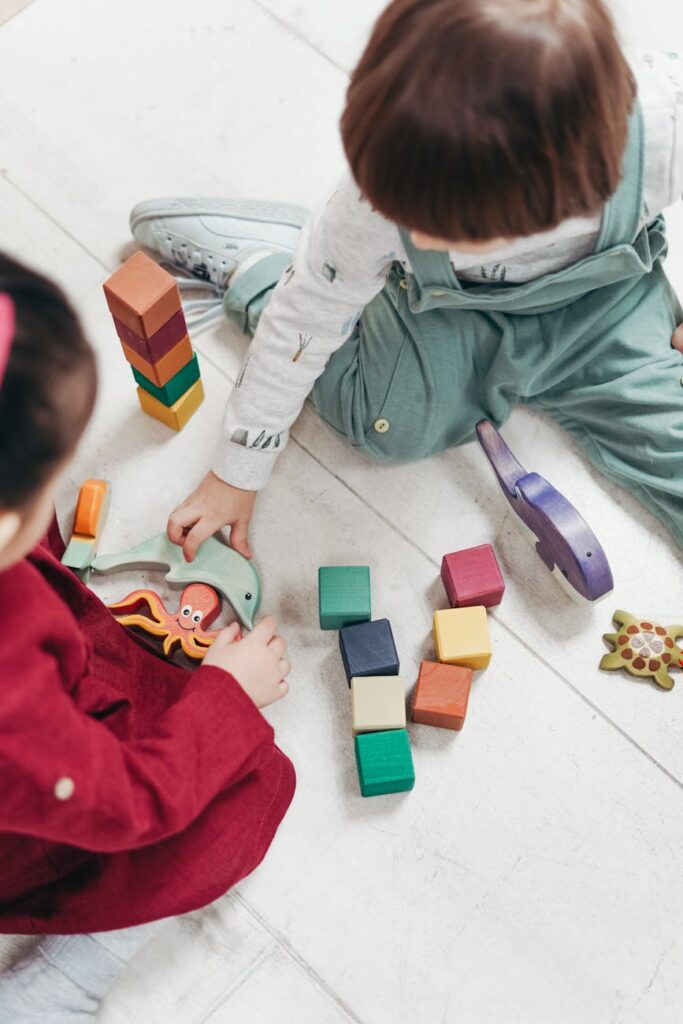
Parallel play gets misunderstood because adults expect toddler friendship to look like older-kid friendship. But toddlers are not tiny adults. At 18 months to 3 years old, many children are still building the basics: attention span, impulse control, language, and the ability to tolerate another child taking “their” bucket, block, or ball. That’s a lot to manage while also trying to stack three cups without a meltdown.
So when parents see parallel play toddlers sitting side by side instead of “sharing,” it can feel disappointing. The truth is, side-by-side play is often the bridge to real peer interaction. It gives children a safe way to watch, imitate, and experiment without the pressure of direct cooperation. That matters because toddler social development starts with observation long before collaboration.
Developmental researchers have long described play as a progression, from solitary play to parallel play to associative and cooperative play. The classic framework comes from Mildred Parten’s work on social participation in children, which still shows up in child development guidance today. If you want a trusted overview of those stages, the American Academy of Pediatrics has a helpful parent-facing breakdown of toddler development.
The hard part is that parents often compare their child’s play to what they expected, not what’s developmentally typical. That comparison can create unnecessary worry — especially if your toddler is shy, language-delayed, or more comfortable in familiar routines.
In other words: the problem isn’t that parallel play is bad. The problem is that it looks too quiet to be recognized for what it really is.
Section 2: The Core Truth About Parallel Play Toddlers — The One Thing That Changes Everything
The single most important thing to understand about parallel play toddlers is this: parallel play is not a lack of social development — it’s social development in its earliest usable form. A toddler doesn’t need to negotiate turn-taking, share a storyline, or build a group game to be learning how people work.
They’re learning by proximity. By watching. By copying. By testing boundaries. That’s the whole point.
Here’s why that matters so much:
- They learn social rules without the emotional overload. A toddler who can’t yet say “my turn” can still learn that other kids use crayons, wait, or laugh when something silly happens.
- They practice attention-sharing. Watching another child play trains a toddler’s brain to notice what someone else is doing, which is a huge early step in empathy and cooperation.
- They build language through imitation. Even if they’re not talking to the other child, they’re hearing words, sounds, and rhythms that feed language growth.
- They get comfortable in groups. Some kids need lots of low-pressure exposure before they’re ready for active playdates or preschool group projects.
A practical example: two 2-year-olds at the same sand table may each dig in their own corner, barely acknowledging each other. But one child notices the other using a scoop, switches tools, and then starts copying the same motion. That is social learning happening in real time.
And yes, the evidence backs this up. Play is strongly linked to social, emotional, and cognitive development, and the National Association for the Education of Young Children has consistently emphasized that play supports the whole child, not just “fun time.”
“Play is the highest form of research.” — Albert Einstein
That line sticks because it’s true for toddlers in the most literal way. They are testing how the world works — one truck, one block, one tiny boundary at a time.
Once you understand that, the next step is learning how to support parallel play without accidentally getting in its way.
Section 3: How to Support Parallel Play Toddlers — A Step-by-Step Breakdown
If you want to encourage healthy parallel play development, don’t force interaction. Structure the environment so interaction can happen naturally, if and when your child is ready.
- Set up side-by-side spaces: Put out two of the same kind of toy — two blocks bins, two art spots, two buckets at the sandbox — so your toddler can play near another child without feeling crowded.
- Choose open-ended toys: Blocks, dolls, pretend food, sticks, scarves, and play dough invite observation and imitation better than toys that only do one thing.
- Keep the playdate short: For many toddlers, 30 to 60 minutes is plenty. Longer can backfire if they’re overtired or overstimulated.
- Stay nearby, but don’t narrate constantly: Let your toddler explore. Jump in only to model gentle language like “You have the blue shovel, and Sam has the red one.”
- Use simple social language: Repeat phrases like “You can play рядом—near her,” “Let’s wait,” and “My turn, your turn” without expecting perfect sharing.
One underrated trick: bring duplicates of the biggest conflict triggers. If there’s one stroller, one dump truck, or one favored scoop, toddlers will often fixate on the exact item another child has. Two of the same toy can save the whole afternoon.
Also, don’t mistake independence for disinterest. Some toddlers look like they’re ignoring everyone, but they’re taking everything in.
Section 4: What the Data Says About Parallel Play
Research on early childhood play consistently shows that peer interaction matters, but the form it takes changes with age. The CDC’s milestones guidance for toddlers highlights that children begin showing more interest in other children and parallel activity as they grow, which is exactly why this stage matters.
At the same time, large reviews of play and development have found that play supports language, self-regulation, and social competence. That doesn’t mean every play session has to look collaborative. It means repetition, imitation, and proximity are part of the developmental engine. If you want the deeper research angle, a good place to start is the National Institutes of Health’s play and development resources and broader early childhood literature on social learning.
Here’s the human version of the data: toddlers don’t jump straight from babyhood to best-friend teamwork. They practice being around people first. That practice pays off later in preschool, classrooms, and eventually friendships.
A Note on the Research
The takeaway is not “your child must be social all the time.” It’s that quiet, side-by-side play is often the exact right level of social exposure for a toddler’s brain and nervous system.
One more useful frame comes from child development experts who remind parents that behavior has to be read in context. The Child Mind Institute regularly notes that developmental behavior is best understood by age, temperament, and environment — not by a single moment in the sandbox.
That means the data should reassure you, not pressure you. And once you know what’s normal, the next challenge is avoiding the traps that make parallel play seem more confusing than it is.
Section 5: The Biggest Mistakes People Make With Parallel Play Toddlers (And How to Avoid Them)
Most mistakes come from loving kids enough to want more for them — too soon. The problem is, pushing a toddler past their developmental stage usually creates more resistance, not more growth.
- Mistake #1 — Forcing sharing too early: Toddlers are still developing object permanence, impulse control, and ownership language, so “share nicely” can be a tall order; instead, teach turn-taking with a timer or a visible count-down.
- Mistake #2 — Expecting constant interaction: Parents often think successful play means nonstop back-and-forth, but parallel play is the stage where comfort grows first; instead, celebrate calm proximity and brief imitation.
- Mistake #3 — Over-scheduling playdates: Too many kids, too much noise, and too long a window can shut a toddler down; instead, keep the group small and the environment familiar.
- Mistake #4 — Labeling a child as “antisocial”: Some toddlers are naturally cautious, slow to warm up, or highly observant; instead, treat temperament as information, not a flaw.
Here’s the blunt truth: a toddler who plays beside others quietly is not missing the point. They are often doing the work in the safest possible way.
And if you’re wondering whether your child needs help, the answer depends on the whole picture — language, eye contact, responsiveness, and overall development — not on one playdate.
Section 6: What the Future of Parallel Play Looks Like
Parallel play is becoming more important, not less, because many toddlers now spend more time in structured settings, digital environments, or smaller social circles than children did decades ago. That makes low-pressure peer exposure even more valuable. The early years are setting the tone for how children handle group spaces, routines, and social overwhelm later on.
Researchers and educators continue to emphasize that play-based learning supports stronger long-term outcomes in self-regulation and social competence. The Harvard Center on the Developing Child has repeatedly highlighted that early experiences shape the architecture of the developing brain, which is a big reason these early play patterns matter so much now.
Why should you care today? Because the habits built in toddlerhood often become the default settings for preschool and beyond. A child who learns that being near others feels safe is a child who has a better shot at joining, cooperating, and connecting later.
That’s not magic. It’s repetition.
Conclusion: The Bottom Line on Parallel Play Toddlers
Parallel play toddlers are not lagging behind. They’re doing the exact kind of social learning that fits their age: watching, copying, tolerating proximity, and slowly building the confidence to engage more directly later. If you understand what is parallel play, you can stop measuring your child against older-kid expectations and start supporting the stage they’re actually in.
The best part? You don’t need a perfect plan. You need a simple one: fewer toys, shorter playdates, duplicate items, and a calm adult nearby who doesn’t rush the process. That’s how parallel play development starts to blossom.
Open a new tab, choose one toddler-safe play space or playdate idea for this week, and set it up with two of the same toy plus a 30-minute timer. Then watch what your child does when the pressure to “perform” is gone.
You’ve got this — and your toddler is doing better than you think.